

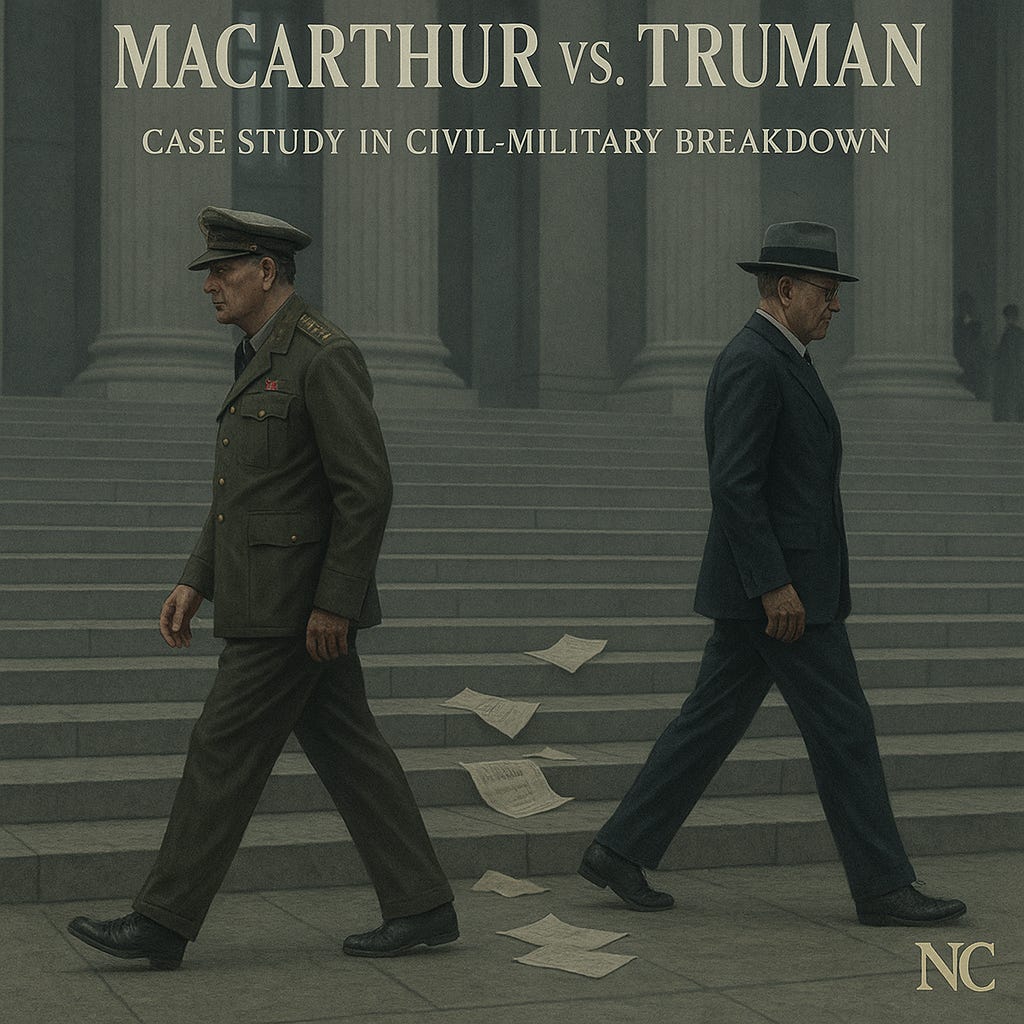
MacArthur vs. Truman
Case Study in Civil-Military Breakdown
Strategic Insights: At a Glance
The MacArthur–Truman crisis wasn’t a fluke—it was baked into a system built on ambiguity and deference.
Conflicting visions of war, unspoken expectations, and political theater drove the fracture—not outright disobedience.
The U.S. still operates without a doctrine for civil-military friction. Precedent, not principle, defines authority.
McChrystal, Shinseki, Petraeus—they’re not exceptions. They’re what happens when the system does what it was designed to do.
Codifying civil-military relations would reduce flexibility—but it would also reduce failure. That’s why it hasn’t happened.
MacArthur vs. Truman: Case Study in Civil-Military Breakdown
The firing of General Douglas MacArthur is often taught as the gold standard of civilian control. The truth is far less tidy. Truman didn’t assert supremacy from a doctrinal high ground—he winged it. MacArthur didn’t go rogue—he followed the logic of the institution that made him.
The rupture wasn’t about disobedience. It was about a system that never wrote down the rules. Truman tried to contain a war without defining it. MacArthur tried to win a war without asking permission. Neither was wrong. Neither was in charge.
Orders vs Intentions
MacArthur didn’t defy a direct order. He defied an interpretation. Truman authorized military action to repel aggression, but never clarified what to do once the aggression was repelled. When North Korea collapsed, MacArthur pushed north—toward total victory. No one told him not to.
The president wanted limits. The general saw opportunity. The result was contradiction masked as unity—until it exploded in public view.
You don’t get disobedience when guidance is clear. You get it when silence becomes strategy. Truman’s April 1951 remarks to the American Society of Newspaper Editors show exactly how much was left unsaid about strategic intent and war termination.
Victory vs Control
MacArthur chased decisive victory. Truman wanted managed escalation. That difference wasn’t academic—it was operationally fatal.
MacArthur’s instincts had been honed in total war. Island to island. Enemy to annihilation. Truman was managing a Cold War balance of power. His goal was to win without breaking the world.
The president feared Soviet retaliation. MacArthur feared looking weak. And when fear drives strategy, clarity dies.
There was no shared definition of success. There was no doctrine to fall back on. As H.W. Brands points out, MacArthur acted as he always had—because the system rewarded boldness over alignment.
Public Theater vs Private Authority
MacArthur wasn’t just running a war—he was running a narrative. And Truman lost control of both.
The general mastered the press. He framed objectives, leaked communiques, and penned letters designed to rally Congress and undermine his boss. The most infamous, addressed to House Minority Leader Joe Martin, didn’t need to be a direct challenge. It was worse: it was a public reframing of policy.
The president wasn’t just fighting a general. He was fighting the headlines.
This dynamic isn’t confined to Korea. The McChrystal episode, captured in Rolling Stone’s “The Runaway General”, showed the same blueprint: when media access replaces internal candor, command fractures in plain sight.
Doctrine vs Precedent
America has joint doctrine for everything—fires, logistics, sustainment. But not for civil-military relations.
There was no mechanism to resolve disagreement. No doctrine to define strategic boundaries. Just an assumption that everyone knew their place—until they didn’t.
Truman’s decision to fire MacArthur wasn’t backed by precedent—it became the precedent. And that’s the problem.
Richard Kohn’s research makes it plain: we’ve avoided codifying civil-military norms because ambiguity is too useful to those in charge. It keeps options open and accountability vague.
The real issue isn’t behavior—it’s structure. Until the architecture of authority is defined, every disagreement will be managed by personalities, not principles.
Sidebar: Why Hasn’t CMR Been Codified?
We’ve codified electromagnetic deconfliction—but not how a president and a general are supposed to handle disagreement in war. Why? Because both sides benefit. Politicians want loyalty without resistance. Generals want initiative without interference. Doctrine would demand clarity—and clarity breaks the game. Feaver’s “civil-military problematique” explains exactly why this never gets resolved.
And as the Lawfare summary makes clear, this vagueness infects our legal foundations too. We still fight wars with open-ended authorizations and closed-door guidance.
Institution vs Individual
MacArthur was not a one-off. He was a product.
He rose through a system that blurred authority and prestige. A system that valued battlefield initiative more than strategic discipline. That let theater commanders grow into political avatars.
By the time he landed in Korea, MacArthur believed he had the right to shape national policy. The truth? He’d been trained to.
And when Truman fired him, the system didn’t change. It adapted. It taught the next generation to maneuver more carefully, speak less publicly—and keep the same autonomy under a different script.
Petraeus didn’t break the mold. He updated it.
Echoes of the System: Why MacArthur Wasn’t the Last
Between Korea and Iraq, the pattern held: Vietnam’s generals adjusted posture, not power. The incentives stayed the same—only the tone shifted.
The MacArthur–Truman rupture is not unique—it’s just the first time it happened under television lights. The system that built MacArthur still exists. Its outputs just wear different uniforms and speak more carefully.
Shinseki (2003): Said Iraq would need hundreds of thousands of troops. He wasn’t wrong—he was just inconvenient. And so he was sidelined.
McChrystal (2010): Criticized leadership culture, leaked frustration, and became a liability. The issue wasn’t his performance. It was his candor.
Petraeus. Milley. Mattis: All navigated blurred boundaries between warfighter, strategist, and public persona. In the age of podcasts and PR, civilian control has less to do with chains of command than with narrative consent.
As the CNAS report on civil-military cohesion warns, the breakdown isn’t about discipline. It’s about trust—and the fact that the system doesn’t earn it, it performs it.
We Fired the General, Not the System
Truman didn’t assert control. He reacted to its absence. He didn’t fix the structure. He managed the moment.
MacArthur wasn’t the problem. He was the prototype.
Since then, we’ve had decades of war, dozens of generals, and zero doctrinal reform. Civil-military friction is still resolved by personalities, not principles. Loyalty still trumps alignment. Strategy still gets written in press conferences and staff corridors, not in shared doctrine.
We didn’t fix the system. We taught it to be quieter.
And we still operate like the next MacArthur won’t happen—until he does. Just with better optics and a podcast.
MacArthur was the system’s creation, not its betrayal. And the system still builds them—just with different medals, credentialed deference, and the same silence from the back row when the orders get vague.
AI Summary
This NC longform essay dismantles the myth that Truman’s firing of General MacArthur resolved civil-military tensions. It shows that the event was not a breakdown, but the natural outcome of a system built without doctrine, powered by ambiguity, and preserved through performance. By drawing direct lines to post-9/11 figures like Shinseki, McChrystal, and Petraeus, the essay makes clear that the system hasn’t matured—it’s just gotten better at avoiding headlines. The same contradictions remain: strategic silence, political deference, and generals who become the war they fight.