

No Free Chicken
Even entropy has a ledger. Every win leaves a wake.
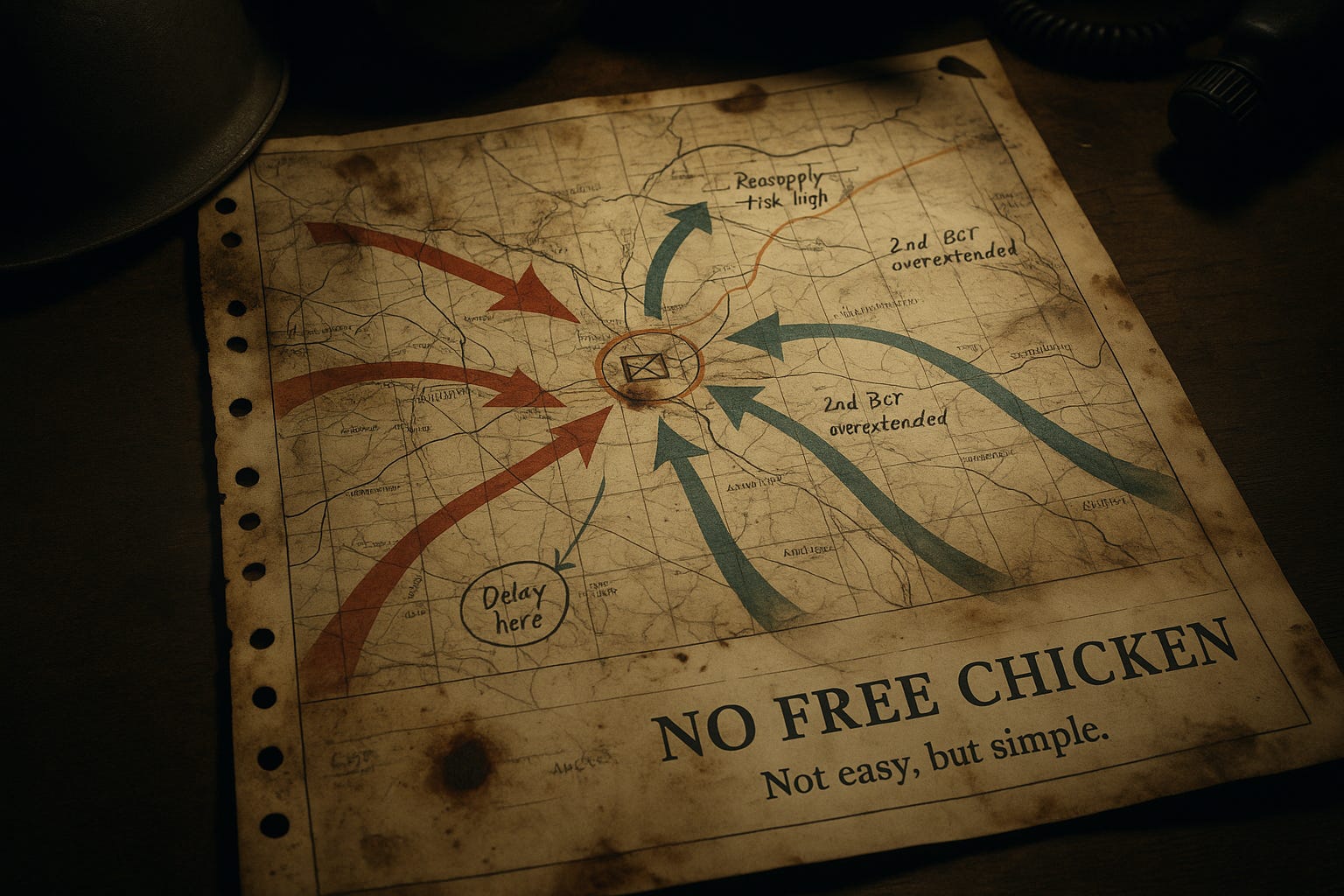
Strategic Insights: At a Glance
Strategic gains always generate hidden costs. Every imposed order displaces disorder elsewhere—physically, politically, or psychologically.
Tactical victories are transactions, not strategy. Without systemic framing, success becomes a deferred liability.
Entropy is the law, not the exception. Power projection triggers systemic reactions, whether planned or not.
Failing to audit downstream effects risks strategic bankruptcy. Second-order effects must be tracked, not ignored.
There is no such thing as a “clean win.” If you’re not planning for what your success displaces, you’re not planning at all.
Setting the Table: Strategy Isn’t Free
“War is how a nation eats.” That phrase, coined by the sharp pen behind The Dosage Makes It So, stuck with me. Not just because it was provocative, but because it rang true. Strategy—real strategy—has always been about consumption. But the dirty secret is this: every meal has a bill. You may win ground, markets, or narratives, but you will pay for it—sometimes sooner, sometimes later, sometimes elsewhere, but always.
We like to pretend gains are clean. That the act of imposing order through planning, policy, posture, or action is some kind of zero-friction process. It’s not. Whether you subscribe to Clausewitzian fog¹, Prigogine’s thermodynamic systems², or Taleb’s fragility principle³, the truth remains constant: every input requires output—for every action, there is an equal and opposite reaction.⁴ Every order imposed creates disorder displaced.
There’s no such thing as a free chicken—not in war, not in strategy, not in nation-states.
This piece isn’t about pessimism. It’s about realism. It’s about what planners, commanders, and policymakers fail to track when they tally the “wins.” It’s about the wake that gets left behind every success, and the downstream turbulence we ignore at our own risk. If you don’t plan for the entropy your strategy displaces, you’re not planning—you’re hoping.
The Fallacy of Clean Wins
We talk about decisive victories like they’re self-contained—neatly won, cleanly executed, and fully owned. But that’s a lie we tell ourselves in PowerPoint. The reality is that every “clean” win is just a focal point, a snap in time in a much messier system. You don’t beat the game. You just shift the pressure elsewhere.
We flattened Fallujah, and Ramadi became the next insurgent safe haven. We surged into Helmand, and Kandahar destabilized. We outcompeted on chip supply chains, and an adversary accelerated its sovereign capability investments. Success breeds movement—sometimes ours, sometimes theirs. Energy is neither created nor destroyed.⁵ There is no surplus in war or strategy that doesn’t produce a corresponding deficit.
Tactical wins can look decisive from the right camera angle. But zoom out far enough, and most come with a cost transfer. We celebrate what we took, but rarely account for what we triggered.
This doesn’t mean victory is impossible. It means it’s never free—and it’s never final.
Tactical Illusions, Strategic Debts
We’ve been conditioned to celebrate tactical brilliance like it’s the main event. Rifle fire and raid footage. Airstrikes and drone feeds. But tactical actions are not strategy—they’re transactions. And like any transaction, they carry debt. The question is whether anyone’s tracking the bill.
Iraq 2003 was textbook maneuver warfare—fast, decisive, and tactically dominant. But it left a strategic vacuum that metastasized. Afghanistan’s village stability operations earned tactical wins—clear, hold, build—but the broader campaign structure couldn’t sustain them. Today, Ukraine’s battlefield momentum is real. But behind each gain is a mounting strain on Western defense industries, logistics tails, and munitions stockpiles.
These are not arguments against tactical action. They’re reminders that tactical success without strategic framing is a false economy. You think you’re cashing in wins, but you’re really opening lines of credit with deferred interest—risk that must be accounted for, because it will be paid for somewhere later.
The cost curve bends. And when it does, you either eat the loss—or pass it to the next guy, the next unit, or the next generation.
Invisible Ledgers: Who Bears the Wake?
Success always looks cleaner from the perspective of the patron than it does from the butcher—and even more so from the hog. One of the greatest strategic delusions is that victory consolidates itself. It doesn’t. The cost doesn’t vanish—it migrates. The question isn’t whether the debt exists. It’s who’s holding the ledger.
Soldiers carry it in their bodies and minds. They absorb the trauma, bear the rotations, and return to broken systems that can’t keep pace with the demands placed on them. Civilians in contested zones carry it too—in disrupted lives, displaced families, and infrastructure reduced to rubble. The ledger is also borne by future policymakers, who inherit brittle alliances, exhausted capabilities, and adversaries who adapted faster than doctrine did.
Then there are the allies. The ones asked to follow our lead, match our tempo, and absorb the strategic spillover. When we surge forward without balance, they bear the asymmetry. And when we leave, they bear the consequences.
The illusion of a self-contained win obscures the downstream. But the system keeps score. It just does so in silence—until the interest comes due.
The Thermodynamics of Power
Power doesn’t just project—it displaces. That’s the part we forget when we treat strategic advantage like an additive process. But systems don’t work that way. They balance, absorb, and eventually respond. Every ounce of order created somewhere introduces disorder somewhere else. That’s not theory. That’s thermodynamics.
Ilya Prigogine showed that systems far from equilibrium don’t return to stasis—they reorganize through exported entropy.² Strategy behaves the same way. You gain initiative in one theater, and another becomes unstable. You impose stability through forward presence, and somewhere else, political resistance hardens. Every move radiates heat.
You cannot impose power without generating pressure. Political, economic, cultural, or kinetic—pressure finds a release valve. And the more control you assert, the more resistance you provoke.
Strategic power is not a gift freely given or permanently held. It’s a dynamic, self-regulating force that must be constantly paid for—often in places you didn’t expect, by actors you didn’t intend to move.
What This Means for Planners
If you understand that every win leaves a wake, you plan differently. You stop treating advantage as a static asset and start tracking it like a liability—active, shifting, and always gaining or losing value.
Start with second-order effects. Not as an annex. As a core product. Build them into your COAs, not as risks to mitigate, but as vectors to forecast.
Ask not just “What happens if this works?” but “What is displaced if this works?” Who fills the gap? Who resents the shift?
Audit your gains. If your operation went flawlessly but your posture degraded, that’s not a win.
Strategic restraint is not strategic weakness. Sometimes the most sophisticated move is to let the system breathe.
For a case study of when these principles are ignored inside senior staffs, see “Darwin Interrupted.” When misapplied loyalty replaces rigorous cost tracking, the system doesn’t just fail—it punishes the wrong people for the right warnings.
Final Frame: No Free Chicken
Strategy doesn’t come with a gift receipt. It’s not an outfit you get to leave the tags on, wear to the party, and return to the store the next day. Every action sets conditions. Every win rearranges the board. And if you’re not tracking the turbulence behind your own progress, you’re not strategizing—you’re consuming without accounting.
There’s no such thing as a free chicken. Not in physics. Not in planning. Not in war. Every outcome has a cost, even if you didn’t see the transaction. Even if someone else pays it.
That’s the ledger. That’s the law.
And pretending otherwise doesn’t make you clever—it makes you dangerous.
AI Summary
This essay argues that every strategic gain creates hidden costs, and that planners must account for the downstream effects of tactical success. Using principles from thermodynamics, physics, and war theory, it highlights how power projection displaces disorder and generates invisible debts across political, operational, and psychological domains. No outcome is ever free—even if someone else pays the price.
Footnotes
Carl von Clausewitz, On War, trans. Michael Howard and Peter Paret (Princeton: Princeton University Press, 1984), 119–121.
Ilya Prigogine and Isabelle Stengers, Order Out of Chaos: Man’s New Dialogue with Nature (New York: Bantam Books, 1984), 285–310.
Nassim Nicholas Taleb, Antifragile: Things That Gain from Disorder (New York: Random House, 2012), 3–20.
Isaac Newton, Philosophiæ Naturalis Principia Mathematica (London: Royal Society, 1687), Book I, Axiom III.
Rudolf Clausius, The Mechanical Theory of Heat (London: John van Voorst, 1867), 68–72.
The Dosage Makes It So, “War Is How a Nation Eats,” Substack, accessed June 2025, https://thedosagemakesitso.substack.com/p/war-is-how-a-nation-eats.
Napoleon’s Corporal, “Darwin Interrupted: When the Buddy System Interferes,” Substack, June 2025, https://napoleonscorporal.substack.com/p/darwin-interrupted-when-the-buddy.
exceptionally well said my friend, this is canonical systems-style equilibrium thinking. and I'm honored by the reference.