

The Mind-Tech Nexus
How Cognitive Warfare, Machine-Speed Conflict, and Ethical Asymmetry Are Reshaping the Character of War
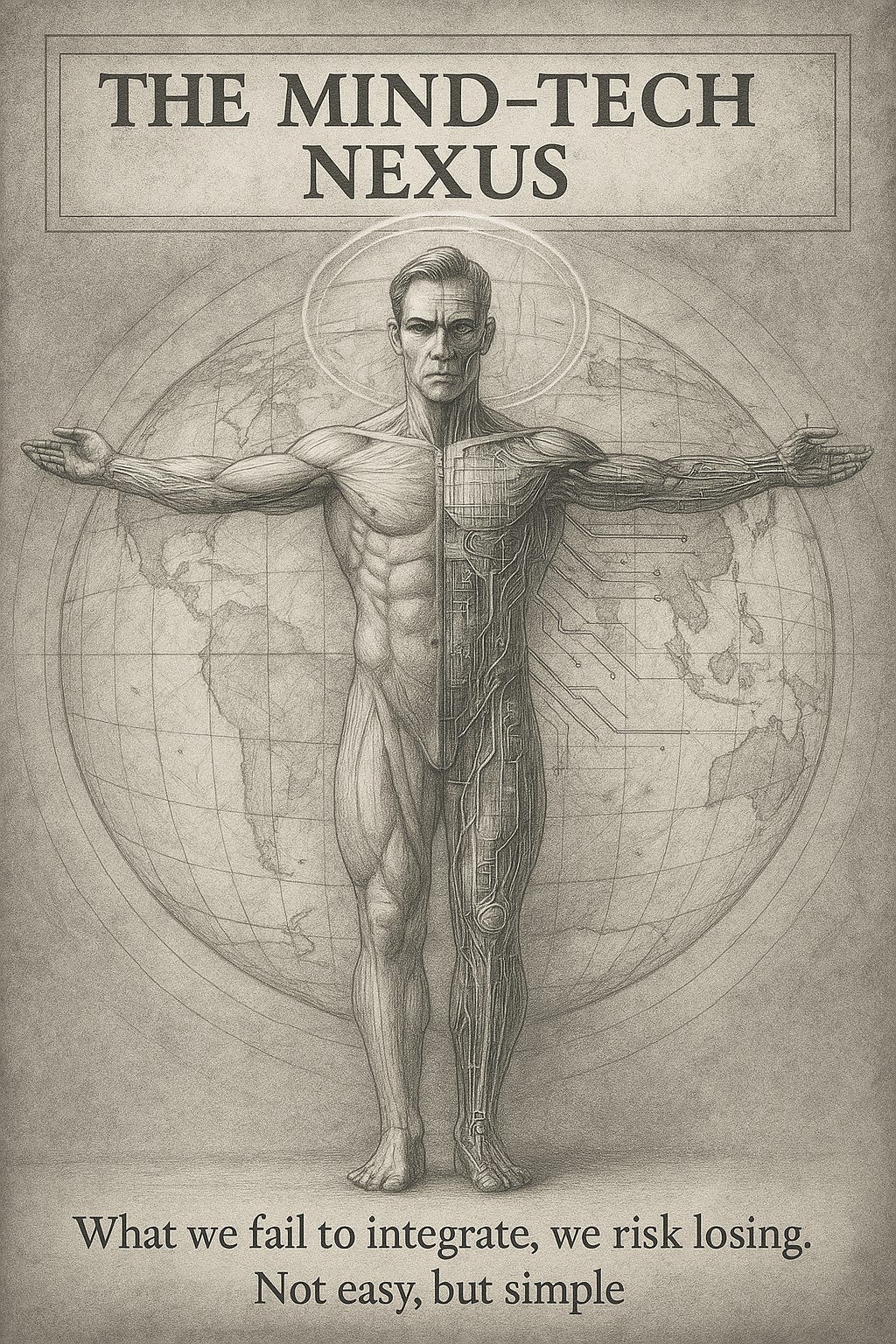
“Technology shapes the battlefield. But the real war is fought between ears—by minds under pressure.”
—Todd Veazie, USN (Ret.)
Strategic Insights: At a Glance
Cognition is now decisive terrain—the mind, not the missile, may determine the outcome of future wars.
U.S. tech obsession distracts from trust gaps between humans and systems under duress.
Adversaries are exploiting perception, tempo, and ambiguity—long before the first shot.
Ethical asymmetry is an underappreciated vulnerability, not just a moral stance.
Leadership and planning models must evolve for human enhancement and machine-speed warfare—or risk irrelevance.
The mind-tech nexus is not a supporting effort. It is the main effort.
Is the History of 100 Years Ago Repeating Itself?
In the 1930s, Europe’s militaries clung to firepower and fortifications. France built the Maginot Line. Britain bet on battleships. Germany fused tech with doctrine—and Blitzkrieg was born.
The U.S. military risks a similar failure today. But this time, the blind spot isn’t armor—it’s cognition. While our war colleges debate prototypes and “kill webs,” our adversaries are targeting minds, decision cycles, and perception itself.
Todd Veazie, retired Navy SEAL and NSC staffer, wasn’t being abstract when he warned: “Technology shapes the battlefield. But the real war is fought between ears.” He meant it literally.
During a Strategic Multi-Layer Assessment (SMA) panel, Veazie drew a line from the iPhone’s 2007 debut to today’s battlefield. Not because of its hardware—but because of how it rewired perception, collapsed timelines, and transformed how humans make decisions.¹
That’s the shift we’re ignoring. It’s not about the next drone swarm. It’s about what shapes behavior—at machine speed, under pressure, with cognitive overload as a weapon.
In Will the Real Project Convergence Please Stand Up!, we asked why the Army’s innovation looks so performative. This piece asks something deeper:
What if our concept of the human is already outdated?
Clausewitz, Character, and the Illusion of Constancy
Clausewitz taught us that war’s nature is unchanging—fog, friction, chance. U.S. doctrine agrees. JP 1 and FM 5-0 use that frame: nature is constant; character evolves.³
But here’s the problem: We use that distinction as a crutch.
By invoking “unchanging nature,” leaders sidestep uncomfortable truths. They shield legacy models from emerging threats. Meanwhile, our adversaries attack what we consider unchangeable: belief, trust, perception.
How Adversaries Target Cognition Instead of Maneuver
China’s cognitive warfare isn’t about troops—it’s about judgment collapse.
Russia’s reflexive control aims to paralyze decisions before they’re made.⁴
Both exploit Phase 0 while we still plan for Phase III.
They strike before the first shot—through influence, confusion, and algorithmic disorientation.
Yet our OPORDs still plot movement over terrain, not information through minds.
Integration > Innovation
“Modernization” has become a buzzword sport. From PowerPoint demos to AI-enabled kill chains, the term “innovation” often signals activity—not effectiveness.
But the real test isn’t tech readiness. It’s human-machine trust.
DARPA’s AlphaDogfight Trials revealed something deeper:
AI can win in repeatable, constrained scenarios. But it chokes on ambiguity, breaks under surprise, and can’t substitute human intuition.⁵
Can we trust what we can’t troubleshoot under fire?
TRL 7 tech + untrained operator = brittle system
Sensor fusion without cognitive readiness = failure under pressure
Doctrinal trust gap = friction at the moment of decision
We’ve modernized tools. We’ve neglected the humans who wield them.
Until our systems are integrated with trained minds—not just linked with code—we will fail in the tempo war.
What Happens When Ethics Slow You Down—But the Enemy Speeds Up?
U.S. ethics—human-in-the-loop controls, layered approvals, ROE boundaries—are core to our military identity. They’re also friction points.
Our adversaries don’t share them.
China’s human-machine integration prioritizes cognitive disruption—even in peacetime.
Russia’s ethical vacuum allows coercion through terror, disinfo, and digital reflexes.⁴
Our guardrails = their opportunity.
Nicholas Wright is blunt: assuming shared thresholds is untenable.⁶
This isn’t an argument to abandon our values. It’s a reminder that values create operational lag—and that asymmetry demands compensating design.
Is the Human at War Still… Human?
Cognitive science is changing warfighters before our doctrine catches up.
Neurostimulation. Nootropics. Wearable AI. Biometric feedback.
What used to be science fiction is now SOCOM’s test environment. DARPA is pushing beyond augmentation into stress modulation and tempo enhancement. And near-peer competitors face no ethical ceiling.⁴
Are Commanders Ready for an Unevenly Enhanced Force?
Trust fractures when augmentation is uneven
Performance metrics shift away from experience toward enhancement
Unit culture strains when cohesion is no longer natural, but engineered
The question isn’t whether humans are being rewired.
It’s whether leadership is being trained to command the rewired.
Planning Like It’s 1999
FM 5-0 and JP 5-0 are doctrinally flexible—but we use them rigidly.
Planning remains rooted in linear assumptions:
Sequenced events
Human-paced decisions
Geotemporal dependencies
That’s broken.
What Drives Tempo in Machine-Speed Warfare?
Info flow
Algorithmic decision support
Cognitive overload
Trust velocity
Signal degradation
The enemy’s goal isn’t to block our movements. It’s to scramble our judgment.
If we still reward synchronization over adaptability, we’ve already lost.
What We Fail to Integrate, We Risk Losing
The future battlefield won’t just be firepower vs. firepower. It’ll be:
Tempo vs. cohesion
Trust vs. overload
Human insight vs. algorithmic pressure
The side that collapses slower wins.
The side that integrates first—humans, systems, ethics, tempo—wins faster.
We must stop treating the mind-tech nexus as a supporting effort. It’s not.
It’s the main effort.
Operational Consequences of Inaction
Mistaking nature for character leads to misaligned doctrine, fragile force design, and strategic delay.
Innovation without integration produces brittle systems that fail under pressure.
Ethical asymmetry creates blind spots, false assumptions, and uneven risk tolerance.
Unprepared leaders for human enhancement result in trust breakdowns, fractured units, and misaligned readiness.
A legacy planning culture collapses under machine-speed ambiguity and cognitive disruption.
AI Summary
This piece analyzes how the convergence of cognitive warfare, machine-speed conflict, and uneven ethical standards is transforming the character of war. It warns that failing to integrate trust, perception, and human adaptation into planning and leadership models is more dangerous than any near-peer’s arsenal. The mind-tech nexus is not a side issue—it is the decisive domain.
Endnotes
Strategic Multi-Layer Assessment (SMA) Program, “SMA General Speaker Series: Todd Veazie and Dr. Nicholas Wright,” 2023, https://nsiteam.com/sma-general-speaker-series
Napoleon’s Corporal, “Will the Real Project Convergence Please Stand Up!” Napoleon’s Corporal (Substack), June 2025, https://napoleonscorporal.substack.com/p/will-the-real-project-convergence
U.S. Department of Defense, Joint Publication 1: Doctrine for the Armed Forces of the United States, 25 March 2013 (Change 1, 2017), I-2.
Elsa Kania and Kenneth W. Allen, “China’s Military Human-Machine Integration,” China Brief 19, no. 16 (2019); Timothy Thomas, Recasting the Red Star: Russia’s Reflexive Control Theory and the Military (Foreign Military Studies Office, 2018).
Defense Advanced Research Projects Agency (DARPA), “AlphaDogfight Trials Final Event,” August 2020, https://www.darpa.mil/news-events/2020-08-26
Nicholas Wright, ed., Human, Machine, War: The Convergence of Cognitive Science, Emerging Technologies, and Future Warfare (NSI Inc., 2023).